

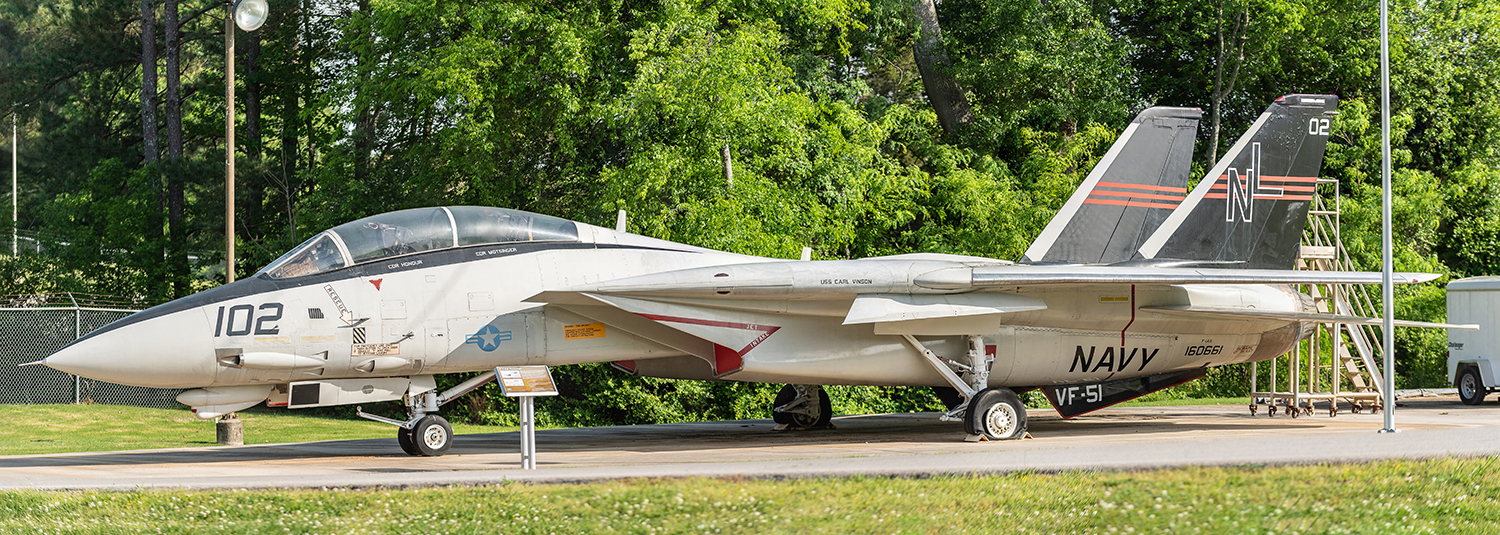
The F-14 Tomcat was a supersonic, twin-engine, variable sweep wing, two-seat fighter designed for the US Navy. The Tomcat was designed to attack and destroy enemy aircraft at night and in all weather conditions. The F-14’s AWG-9 radar was a powerful Pulse-Doppler, multi-mode system that tracked up to 24 targets simultaneously, attacked six targets with its Phoenix AIM-54A missilesclosed-circuit while continuing to scan the airspace. Air-to-air armament also included AIM-7 Sparrow, AIM-9 Sidewinder, AIM-120 AMRAAM, and am internal 20-mm M61 Vulcan Gatling-type gun fitted on the left side. The Tomcat was also able to perform precision strikes against ground targets and tactical reconnaissance. The wings were shoulder-mounted and programmed for automatic sweep during flight, with a manual override ability. Normal sweep range was 20 to 68° with a 75° “over sweep” position for shipboard hangar stowage; sweep speed is 7.5° per second. The cockpit had a Heads-Up Display (HUD) co-located with a vertical situation display and a horizontal situation display. A Television Camera Set (TCS) was used for visual target identification at long range. Mounted on a chin pod, the TCS is a high-resolution closed circuit television system with display in the cockpit that could also be recorded. This aircraft, an F-14A, Bureau Number 160661, was a part of Navy Fighter Squadron VF-51, aboard the USS Carl Vinson (CVN-70) on its maiden voyage and in VF-124 at Naval Air Station Miramar, CA, where it served as a training aircraft. This aircraft also participated in a NASA effort to improve F-14 maneuvering.